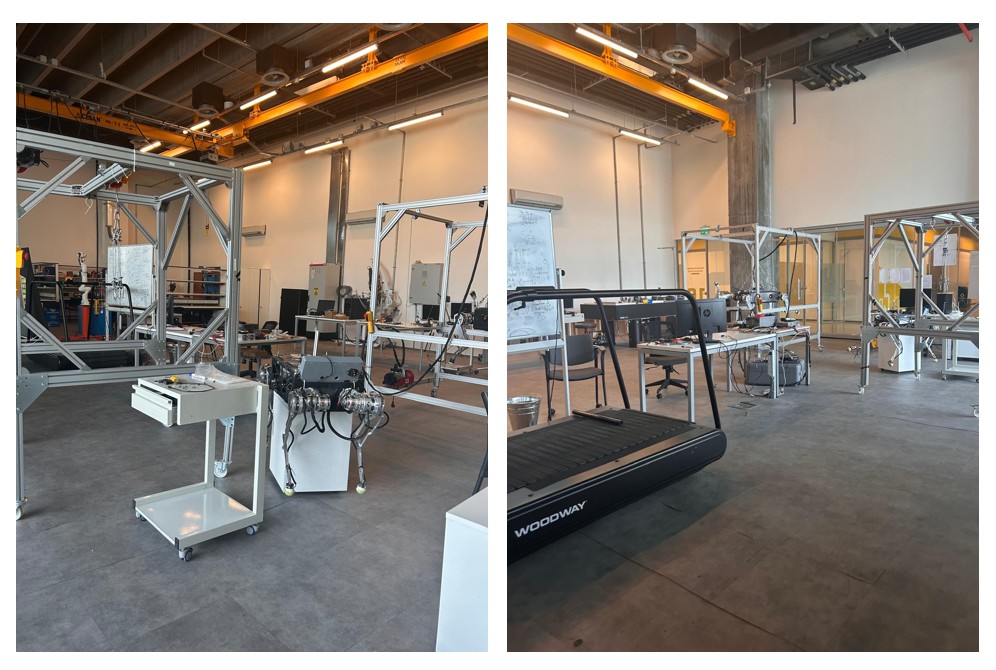
The Biomechatronics Laboratory occupies approximately 280 m² of dedicated research space designed to support cutting-edge research in robotics, biomechatronics, and human–robot interaction. The facility provides a bright and spacious working environment for researchers and students, with dedicated areas for hardware prototyping, high-precision manufacturing, robot assembly, and experimental locomotion studies.
The laboratory is equipped with a 1000 kg-capacity overhead winch, enabling the safe handling and testing of large robotic systems and experimental platforms.
2. Custom-Built Robotic Systems
Our laboratory is capable of building state-of-the art legged systems.
2.1. Quadruped Robots
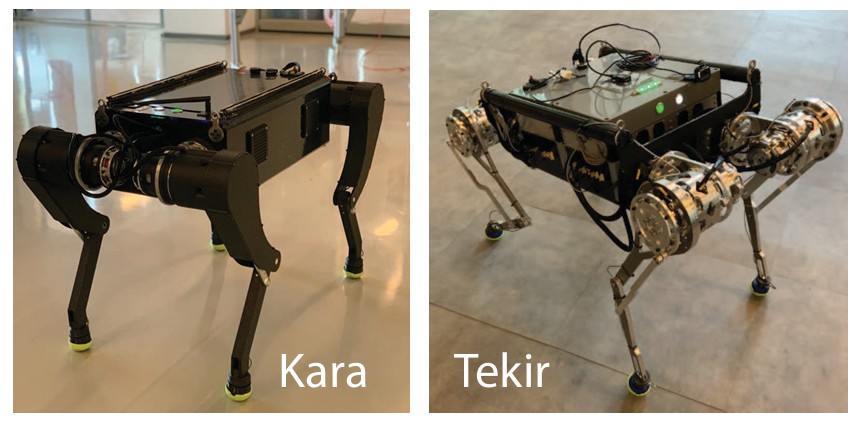
The laboratory has developed two generations of fully torque-controlled quadruped robots for advanced locomotion research. Designed and manufactured in-house, these platforms integrate high-performance actuation, precision sensing, and onboard computation, enabling experimental studies on locomotion control, reinforcement learning, whole-body control, and physical human–robot interaction.
The figure on the right illustrates our second-generation quadruped robot platform, Kara.
2.2. Exoskeleton Systems
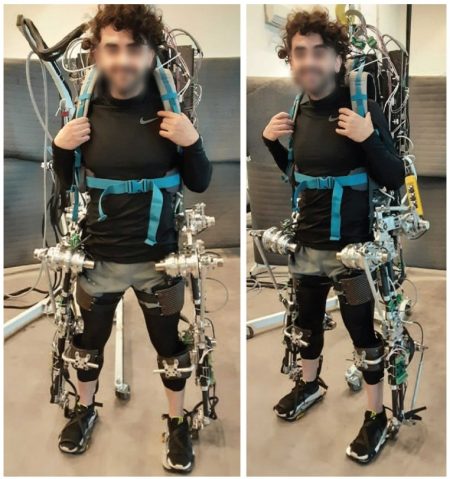
The laboratory has developed two generations of lower-limb robotic exoskeletons featuring series elastic actuation and full torque controllability. These systems provide high-fidelity force control and rich sensing capabilities, enabling research on gait assistance, physical rehabilitation, human motor adaptation, and human–robot interaction.
The figure on the right presents our first-generation exoskeleton platform, Co-Ex.
Large hero images work particularly well here.
Co-Ex: A Self-Stabilizing Lower-Body Exoskeleton(Soliman et al., 2025)
3. Commercial Robotic Platforms
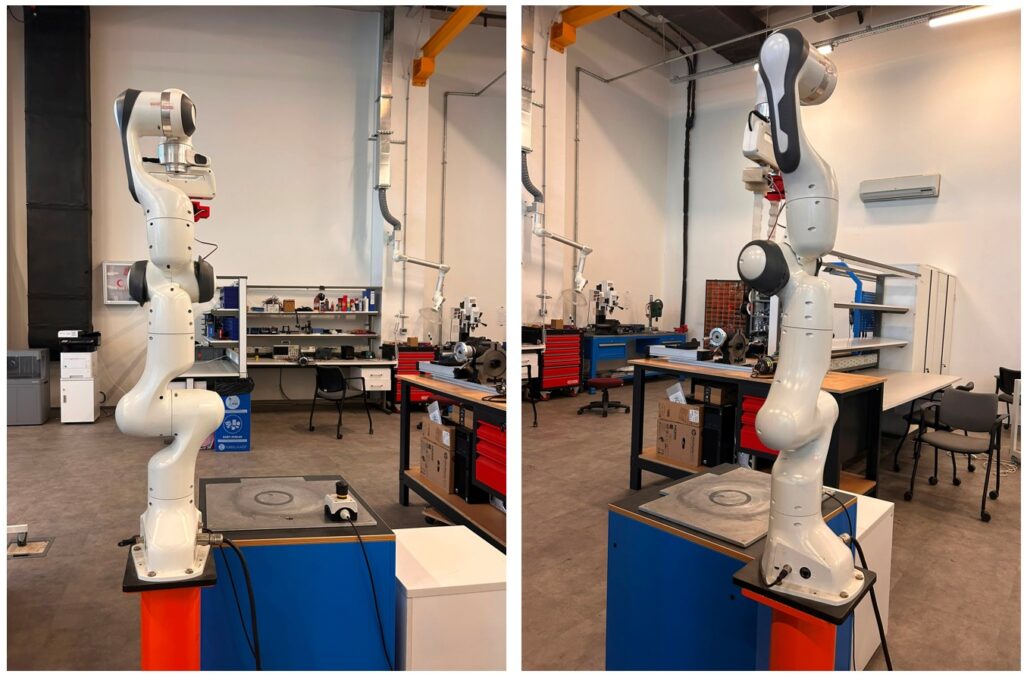
The laboratory is equipped with a Franka Emika Panda 7-degree-of-freedom robotic manipulator for research in robot manipulation, force control, and human–robot interaction. The platform provides direct torque control capabilities and is equipped with an adaptive gripper for dexterous manipulation tasks.
In addition, the laboratory operates a Unitree Go2 quadruped robot that supports research in autonomous locomotion, navigation, and reinforcement learning.

Go2: Controlled using our in-house whole-body control software.
4. Manufacturing and Experimental Infrastructure
The laboratory houses a Thorlabs optical table workstation (1.2 m × 2.5 m × 210 mm) that provides a vibration-isolated platform for precision mechatronics integration, sensor characterization, calibration procedures, and experimental validation.
Rapid prototyping is supported by a Markforged X7 industrial 3D printer capable of producing high-strength composite components using Onyx reinforced with Fiberglass, Carbon Fiber, Kevlar®, and HSHT Fiberglass materials.
Through our sister laboratories, researchers also have access to advanced manufacturing facilities, including Spinner VC 750 CNC milling and Spinner TC 400 CNC turning centers, both offering micron-level machining accuracy. Additional fabrication resources include wire EDM machining, horizontal band saws, and pillar drilling equipment for advanced mechanical hardware development.
5.Motion Capture and Human Motion Analysis
The laboratory has access to state-of-the-art motion capture technologies for biomechanics, locomotion, and human–robot interaction research. These include an OptiTrack S250e optical motion capture system capable of sub-millimeter tracking accuracy at up to 250 Hz, as well as an Xsens inertial motion capture suit operating at up to 240 Hz.
Together, these systems provide a high-fidelity experimental platform for real-time kinematic analysis, gait assessment, and human–robot interaction studies.
6.Simulation and Computational Resources
The laboratory extensively employs physics-based simulation tools to accelerate robotics research and development. Raisim serves as the primary simulation environment for robot locomotion, manipulation, and contact-rich interaction studies. Gazebo is additionally utilized for ROS-based development and sim-to-real transfer workflows.
For machine learning and reinforcement learning research, the laboratory uses NVIDIA Isaac Sim and Newton to support large-scale robotic simulation and accelerated algorithm development. Dedicated GPU workstations enable parallel simulation of thousands of robotic environments, facilitating efficient training and rapid convergence of learning-based controllers.
Students and researchers at Özyeğin University have access to MATLAB and Simulink, including the complete educational toolbox suite. Additional software resources include Autodesk products, MSC ADAMS, CATIA, ANSYS, and Adobe Illustrator, depending on project requirements.
While commercial software is available when needed, the laboratory primarily develops its research infrastructure using Linux-based open-source tools and frameworks. Experience with Ubuntu Linux and modern C/C++ development is therefore highly beneficial for prospective students and researchers.